
Best Time to Pour Concrete in Utah: Holladay Seasonal Guide
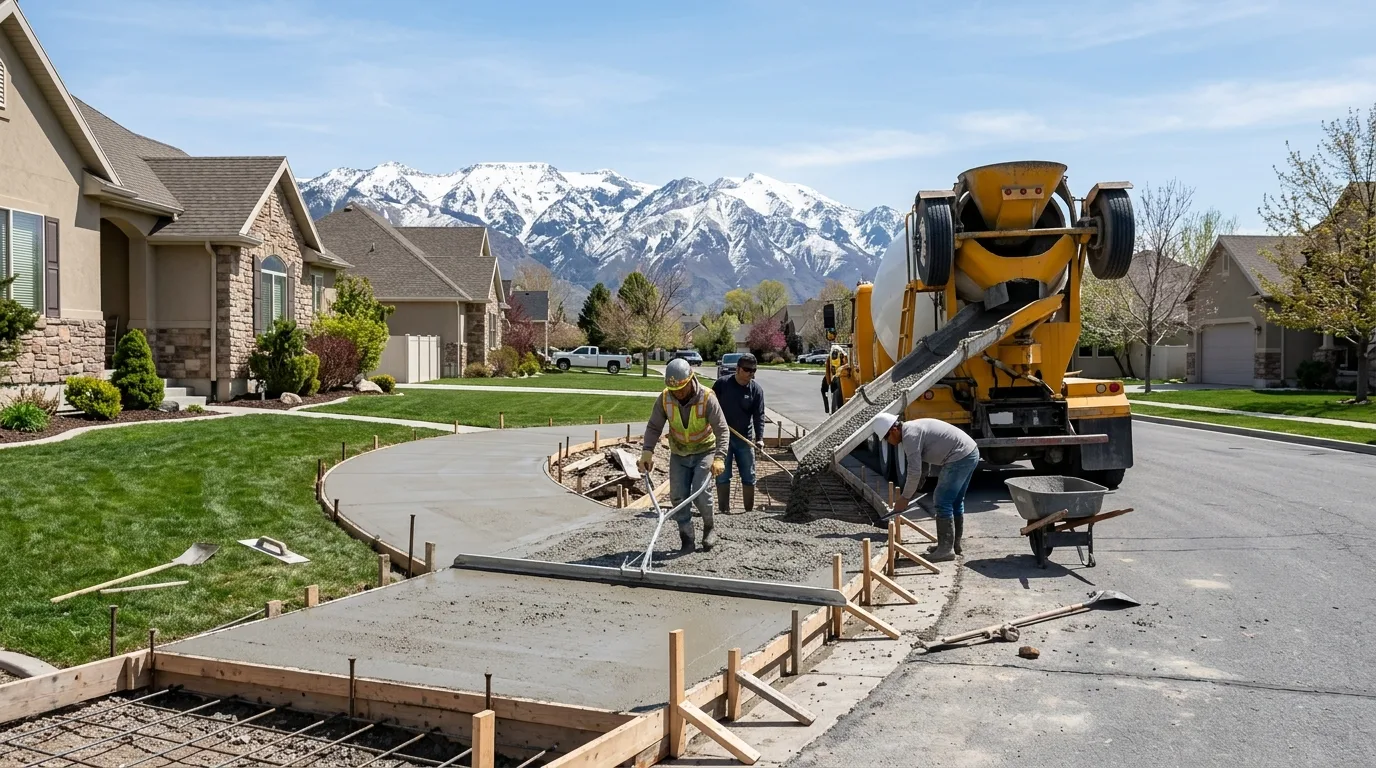
Holladay homeowners who plan their concrete projects around Utah’s seasonal calendar get stronger concrete, fewer installation problems, and better pricing availability than those who try to fit a pour in whenever the schedule opens. The difference between a spring driveway project and a mid-January pour isn’t just convenience — it’s a meaningful difference in concrete quality and long-term performance.
In this post, we cover the best and worst months for concrete work in Holladay, what temperature ranges produce optimal curing, how each season affects concrete quality, and how to time your project for best results and best contractor availability.
Schedule Your Holladay Concrete Project
Call Holladay Concrete Pros to check availability and schedule your spring or fall project before peak season fills up.
Why Seasonal Timing Matters for Concrete in Holladay
Concrete is a chemical reaction — Portland cement reacting with water to form the crystalline matrix that gives concrete its strength. That reaction is temperature-dependent. Too cold and it slows to the point where early frost can damage the concrete before it reaches structural strength. Too hot and the reaction accelerates, causing rapid moisture loss that produces a weaker surface and increases cracking risk. In Holladay, both extremes are real seasonal concerns.
The concrete curing window for optimal results is 50–80°F ambient temperature. In Salt Lake County, that window is most reliably available in April through June and September through October — about four to five months of the year when conditions are genuinely favorable. The other seven months require either cold-weather measures, hot-weather measures, or both.
Types of Seasonal Conditions in Holladay
Spring (April–June): Best overall window. April through June brings temperatures in the 50–75°F range, lower contractor backlog than summer, and longer daylight hours for completion. Spring snowmelt can create wet soil conditions that require attention before subgrade work begins, but once drainage clears, spring is the ideal concrete season in Holladay. Scheduling a spring pour also means your new concrete patio or driveway is cured and ready for use by peak summer entertaining season.
Summer (July–August): Manageable with care. Holladay’s summer average high reaches 91°F in July — hot enough to accelerate moisture loss on freshly poured concrete, which can produce a weaker surface if not properly managed. Experienced contractors schedule summer pours for early morning, use evaporation retarders, and apply wet curing methods to compensate. Summer is peak season — contractor availability is tightest and pricing may reflect demand. Lead times stretch from the typical 1–2 weeks to 4–6 weeks in July.
Fall (September–October): Excellent, often underutilized. September and October offer Holladay’s best combination of ideal temperatures, lighter contractor backlog than summer, and concrete that cures before the first serious freeze. October projects do require attention to nighttime temperatures — once lows start dropping below 40°F, cold-weather measures become necessary. A well-timed October pour can be an excellent opportunity to complete a project with shorter lead times and potentially better contractor scheduling.
Winter (November–March): Avoid when possible. Holladay’s average January low is 22°F — well below the threshold for concrete work without cold-weather management. Concrete poured in freezing conditions that freezes before reaching adequate strength can lose 50% or more of its design strength — a permanent, invisible defect. Cold-weather concrete work requires accelerators, heated enclosures, insulating blankets, and temperature monitoring. This adds $3–$8 per square foot to project cost and significantly increases the complexity and risk. Most residential concrete projects in Holladay should avoid December through February.
Practical Uses for Seasonal Planning
- New driveway: Schedule for April–May to get ideal curing and have the driveway ready well before winter. Avoid October starts that might push the pour into November.
- Stamped concrete patio: Prioritize spring installation — stamping requires a longer working window that Utah’s summer heat shortens significantly. April through early June is ideal for complex decorative projects.
- Concrete repair: Minor crack fills can be done year-round with appropriate temperature management. Major resurfacing projects should target spring or fall.
- Foundation work: May through October. Frozen ground makes excavation harder and more expensive; avoid December through March unless project timing is absolutely fixed.
- Concrete walkways and steps: Spring and fall. Summer installs are fine; avoid winter when ground freeze complicates subgrade preparation.
- Emergency repairs: Safety hazards like severely heaved or crumbling steps can be addressed year-round — we adapt with appropriate cold-weather procedures when necessary.
Plan Your Holladay Concrete Project for the Right Season
Holladay Concrete Pros advises on optimal scheduling for your specific project — call (888) 376-0955 for availability.
How Concrete Curing Works in Holladay’s Climate
Concrete gains strength progressively: approximately 70% of design strength at 7 days, 99% at 28 days under ideal 70°F conditions. Cold weather slows this progression — at 40°F, concrete may take 3× as long to reach the same strength milestone. If concrete freezes before reaching 500 PSI compressive strength (which happens in the first few hours after placement), the ice crystals disrupt the cement matrix permanently.
Holladay’s elevation of 4,465 feet compounds the cold weather challenge — the Wasatch Front’s thin air at elevation loses heat faster than lower-elevation sites in similar latitudes. Night temperatures drop significantly even in early spring and fall, which means concrete poured on a warm spring afternoon may still be at risk from overnight frost in March and early April. We monitor overnight low forecasts carefully when scheduling early-season pours in the Olympus Cove and Olympus Hills neighborhoods, where elevation adds another 200–400 feet above Holladay’s base.
Hot weather curing challenges are the mirror image: rapid evaporation from hot pavement, direct sun, and low humidity (Salt Lake County’s average relative humidity in July is roughly 25–30%) can dry the concrete surface faster than it cures, producing a weak, dusty surface layer. Early morning pours, shade screens, and curing compound address this — but they add cost and scheduling constraints that spring and fall projects don’t face.
Cost Factors: Seasonal Pricing in Holladay
Spring and fall projects typically offer better pricing availability than summer because demand is lower. July and August represent peak season for concrete contractors in Salt Lake County — backlog is highest and some contractors carry a peak-season premium. Planning a project for April or September often means better availability, more responsive scheduling, and potentially 5–15% better pricing simply from scheduling out of the peak window.
Winter surcharges for cold-weather concrete measures — accelerators, blankets, temporary heat — add $3–$8 per square foot to any pour that requires them. A driveway that costs $10/sq ft in May might cost $15–$18/sq ft in January if the project is urgent enough to proceed in freezing conditions.
Frequently Asked Questions
What is the minimum temperature to pour concrete in Holladay?
Concrete should not be poured when air or ground temperatures are below 40°F without cold-weather procedures (heated enclosures, insulating blankets, accelerating admixtures). Even with these measures, concrete poured in very cold conditions is at higher risk and requires careful temperature monitoring for at least 7 days. The optimal range is 50–80°F ambient temperature throughout the pour and initial curing period. In Holladay, this reliably occurs April through October.
Can concrete be poured in the rain in Utah?
Light rain is generally not a problem — it adds surface water but concrete has enough water in the mix to tolerate brief rain after placement. Heavy rain before concrete reaches initial set can dilute the surface and damage the finish. We monitor weather forecasts and reschedule pours when heavy rain is expected within 4 hours of the pour window. After initial set (2–4 hours), rain is harmless and can even help slow-cure the surface in hot weather.
When should I schedule my Holladay concrete project to avoid waiting?
To avoid peak-season backlog, schedule your project before Memorial Day or after Labor Day. April and May have the shortest lead times of the outdoor season. September is excellent — temperatures are still warm, contractor schedules open up after the summer rush, and fall curing conditions are ideal. Calling in February or March to schedule a spring project gives you the best pick of available dates across the best curing window of the year.
Schedule Your Holladay Concrete Project Now
Call Holladay Concrete Pros at (888) 376-0955 — we'll advise on optimal timing and schedule your project for the best possible conditions.
Related: