
Holladay Concrete: How to Protect It Through Utah Winters
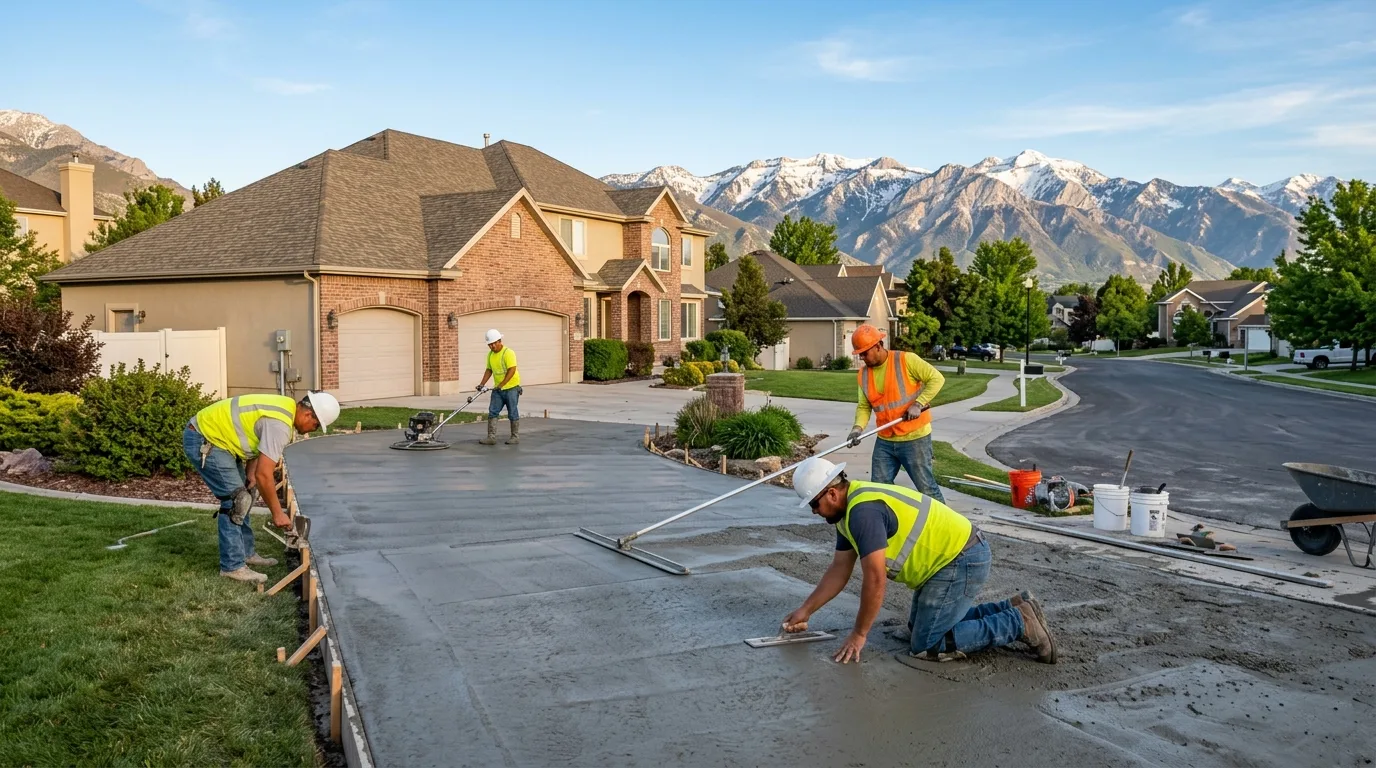
Every November, Holladay homeowners face the same decision: prepare their concrete for winter, or leave it and deal with the consequences in spring. The consequences in Salt Lake County are real — 100+ freeze-thaw cycles between November and March can turn minor surface cracks into major damage within a single winter if moisture is allowed to infiltrate freely. The cost of prevention is a fraction of the cost of repair.
In this post, we cover the specific steps Holladay homeowners should take before winter, what to do (and what not to do) during snow and ice events, how to assess your concrete after winter, and when to call for professional assessment.
Pre-Winter Concrete Assessment in Holladay
Call Holladay Concrete Pros before winter — we'll assess your concrete condition and advise on sealing and repair needs.
Why Holladay Winters Are Hard on Concrete
The homeowner who discovers their driveway is scaling in spring often assumes it “just aged out.” More often, the damage accelerated through a series of specific winter events. First, fall rain saturates the concrete surface and fills existing cracks. Then temperatures drop below 32°F — which happens over 100 times annually at Holladay’s 4,465-foot elevation — causing that water to freeze and expand by approximately 9% in volume. On the thaw, the crack is slightly wider. On the next freeze, more water enters the now-larger crack. Repeat 100 times over three to four months and the cumulative mechanical damage is significant.
The additional element in Holladay is snow removal equipment and de-icing product choices. Steel-bladed snowplows damage concrete sealer and edges. Chloride-based de-icing salts — which most hardware stores sell as “ice melt” — penetrate concrete, suppress the freezing point at the surface (causing more frequent freeze-thaw cycles in the top ¼ inch), and accelerate corrosion of any embedded steel reinforcement. In the Olympus Cove neighborhood and throughout Holladay’s hillier terrain, the temptation to use aggressive de-icers on sloped driveways is strong, but the long-term concrete cost is high.
Types of Winter Concrete Protection
Penetrating concrete sealer is the most effective single winter protection measure available to Holladay homeowners. A silane-siloxane penetrating sealer bonds chemically to the concrete and creates a hydrophobic barrier that repels water infiltration — the essential first step in freeze-thaw damage prevention. Sealed concrete can still experience freeze-thaw cycling, but without moisture freely infiltrating the slab, the mechanical damage mechanism is dramatically slowed.
Crack filling before winter is the highest priority repair for any Holladay homeowner who sees open cracks in their driveway or patio. An open crack before November is a freeze-thaw damage accelerator — it fills with water on every rain and snowmelt event and then cycles through freeze-expansion repeatedly. A properly applied polyurethane crack fill in October or early November costs $300–$500 and prevents the crack from doubling in width through the winter.
Snow removal practices matter for concrete longevity. Plastic shovels and plastic-bladed snow blower paddles are gentler on concrete surfaces and sealer than metal alternatives. Push snow away from the edges of concrete slabs — letting snow banks press against concrete edges concentrates freeze-thaw stress at the most vulnerable part of the slab.
De-icing product selection is critical. Use sand for traction — it provides grip without chemical damage to the concrete surface. Calcium magnesium acetate (CMA) is a concrete-safe de-icing product if chemical de-icing is necessary for safety. Sodium chloride (rock salt), calcium chloride, and magnesium chloride all damage concrete surfaces and should not be used on any concrete in Holladay, including driveways, walkways, and steps.
Practical Winter Protection Checklist
- Before November: Inspect all concrete surfaces for open cracks (fill any over ¼ inch wide), check that sealer is intact (water should bead on sealed concrete — if it soaks in, resealing is needed), and clear debris from drainage paths adjacent to concrete.
- Maintain drainage: Ensure that downspouts are directing water away from concrete slabs — a downspout discharging onto a concrete driveway or patio creates a persistent moisture source that dramatically accelerates freeze-thaw damage.
- After snowfall: Clear snow with a plastic-bladed shovel or blower. Avoid letting snow accumulate into heavy ice packs that are harder to remove and require more aggressive methods.
- Traction: Apply sand before expected ice events rather than after ice forms. Pre-application is safer and requires less total material.
- During thaw events: Clear melting snow and standing water from concrete surfaces to minimize the amount available to refreeze during overnight temperature drops.
- Spring inspection: After the last hard freeze, inspect all concrete surfaces for new cracking or surface scaling that developed through the winter. Address new damage in spring before the next winter cycle begins.
Holladay Concrete Sealing and Repair Services
Holladay Concrete Pros handles pre-winter sealing and crack repair throughout Salt Lake County — call (888) 376-0955.
How Winter Maintenance Prevents Costly Spring Repairs
The Olympus Hills neighborhood provides a useful case study in maintenance variation. Two identical driveways installed in the same year — one consistently sealed and maintained, one not — will look dramatically different after 10 winters. The maintained driveway shows minor edge wear at most; the unmaintained one may be showing surface scaling across 30–40% of the area with cracks that have opened to ½ inch or more. The cost of sealing every 4 years ($300–$600) compared to resurfacing ($1,500–$4,000) or replacement ($6,000–$12,000) makes the maintenance investment straightforward.
The key insight is that concrete damage in Holladay’s climate is cumulative and accelerating: each winter of deferred maintenance leaves the concrete more vulnerable to the next winter’s damage. A driveway that is 80% sound going into winter emerges at 70% sound — while a driveway that is 40% sound going into winter might emerge at 20%. The same 100 freeze-thaw cycles cause dramatically more damage to a concrete surface that is already compromised.
Cost Factors: Winter Protection vs. Repair
Pre-winter concrete sealing in Holladay: $300–$600 for a standard driveway (every 3–5 years). Pre-winter crack filling: $300–$500 for isolated crack fills. Annual cost of proper winter maintenance for a typical Holladay driveway: roughly $150–$200 per year averaged over the sealing cycle. Contrast this with resurfacing cost ($1,500–$4,000) or full replacement ($6,000–$12,000) — the maintenance economics are clear. We recommend Holladay homeowners schedule a fall inspection annually and address any needed sealing or crack fills before December.
Frequently Asked Questions
When should I seal my Holladay concrete before winter?
September and October are ideal for pre-winter sealing in Holladay. Concrete must be dry for at least 48 hours before applying penetrating sealer, and temperatures should be between 40–90°F during application and for 24 hours after. Avoid sealing in November when temperatures can drop near or below 40°F overnight. If your concrete is overdue for sealing, a fall seal is significantly more valuable than waiting until spring — it protects through the most damaging part of the year.
What de-icing products are safe for Holladay concrete?
Sand is the safest and most effective traction material for concrete in Holladay — it provides grip without any chemical damage. Calcium magnesium acetate (CMA) is concrete-safe if a chemical de-icer is needed. Avoid sodium chloride (rock salt), calcium chloride, magnesium chloride, and any product containing urea — all are damaging to concrete surfaces and are particularly harmful to decorative stamped or sealed concrete. De-icing product damage to concrete is cumulative; even one or two seasons of salt use on unprotected concrete can initiate surface scaling.
How do I know if my concrete needs to be resealed before winter?
Pour a small amount of water on the concrete surface. If it beads up and stands on the surface, the sealer is still effective. If it soaks in immediately, the sealer has worn off and resealing is needed before winter. For concrete that has never been sealed, any water absorption test will show immediate penetration — these surfaces are especially vulnerable and should be prioritized for fall sealing. Our spring maintenance checklist covers post-winter assessment in detail.
Protect Your Holladay Concrete This Winter
Call Holladay Concrete Pros at (888) 376-0955 for pre-winter concrete sealing, crack repair, and assessment throughout Salt Lake County.
Related: