
Choosing a Concrete Contractor in Holladay UT
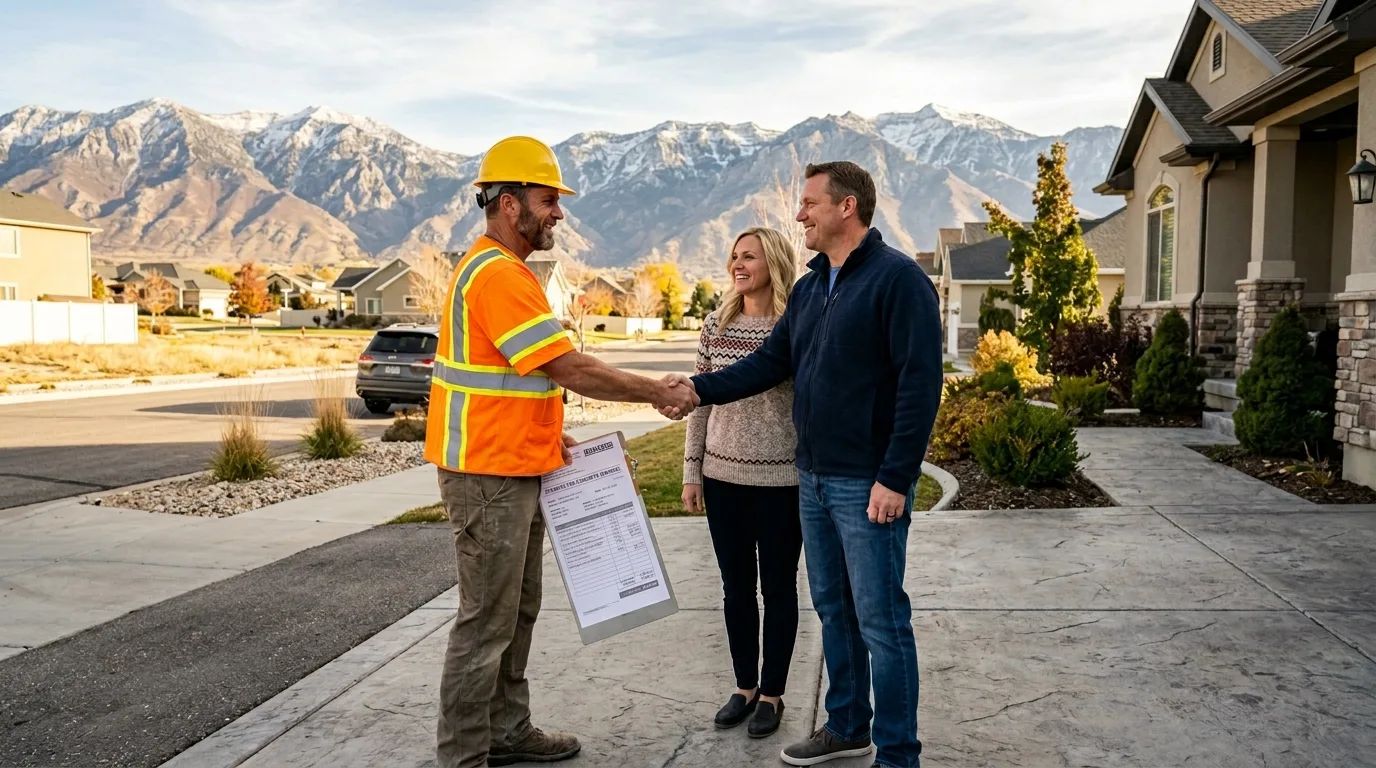
Hiring the wrong concrete contractor in Holladay is a mistake that compounds every winter. Improper mix design, inadequate subgrade preparation, or skipped permits produce a driveway or patio that fails years ahead of schedule — and the contractor who did the work is long gone by then. The good news is that the questions that separate quality contractors from risky ones are specific and easy to ask before you sign anything.
In this post, we cover the 7 most important questions to ask any concrete contractor in Holladay, what acceptable answers look like vs. red flags, and how to structure the bid comparison process to get an accurate apples-to-apples comparison.
Questions About Our Approach? Just Ask.
Holladay Concrete Pros welcomes all vetting questions — transparency is part of how we work. Call for a free estimate.
Why Contractor Selection Matters More in Holladay Than in Other Markets
Most building materials are forgiving of modest installation shortcuts in temperate climates. Concrete in Holladay is not. Salt Lake County’s 100+ annual freeze-thaw cycles at 4,465 feet elevation, combined with the expansive clay soils that are prevalent throughout the Olympus Hills and Olympus Cove neighborhoods, create conditions where proper mix design and subgrade preparation are not optional — they’re the difference between a 40-year installation and a 10-year one. The two most common sources of early concrete failure in Holladay are both contractor decisions: wrong concrete mix (standard vs. air-entrained) and inadequate subgrade preparation.
Neither of these shortcuts is visible on the finished concrete surface. You cannot look at a freshly poured driveway and determine whether it was correctly air-entrained or whether the subgrade was properly prepared. This asymmetric information problem is why the questions you ask before the pour happen are so important.
Types of Red Flags vs. Green Flags by Question
Q1: What concrete mix design will you use?
Green flag: “We use 4000–5000 PSI air-entrained concrete for all exterior projects in Utah. The air content target is 4–6% for freeze-thaw durability. I can give you the mix spec in writing.”
Red flag: “Standard concrete.” No PSI number mentioned. No mention of air entrainment. Cannot specify air content when asked directly.
Air-entrained concrete is the non-negotiable specification for exterior flatwork in Holladay. Any contractor who cannot answer this question specifically — or who proposes a standard 3000 PSI non-air-entrained mix — is not building to Utah climate standards.
Q2: How will you prepare the subgrade?
Green flag: “We excavate to [specific depth], remove the expansive topsoil, bring in [specific base material], compact to [specific grade/spec], and grade for [specific drainage slope]. For your site specifically, I expect [site-specific notes].”
Red flag: “We’ll prep the base before we pour.” No depth mentioned. No base material specified. No drainage slope discussion. Cannot answer when pressed for specifics.
In Holladay’s clay soil environment, the subgrade preparation is more important than almost any other project element. A contractor who cannot describe their subgrade process specifically has not thought through your specific site conditions.
Q3: Will you pull the required Holladay permit?
Green flag: “Yes, we submit through Holladay’s iWorq portal. For your project type [driveway/patio/RV pad], we’ll get the Zoning and Engineering compliance review. Plan for about 7–10 business days for review before we can start.”
Red flag: “We don’t usually worry about permits for small projects.” Or: “That’s your responsibility as the homeowner.” Permit liability sits with the property owner. Unpermitted concrete work in Holladay can create stop-work orders, require demolition, and complicate future property sales.
Q4: Can I see your license and insurance certificates?
Green flag: Immediate yes, followed by actual provision of certificates. General liability insurance (minimum $500,000) and workers’ compensation insurance are the two key documents. License number verifiable with Utah’s Division of Occupational and Professional Licensing.
Red flag: Hesitation, vague responses, promises to provide later that are not fulfilled, or references to licenses held by related entities rather than the actual contractor.
Q5: Can you give me three recent references from similar projects in Salt Lake County?
Green flag: Immediate provision of names and phone numbers. References who have been customers for at least one full winter season so you can ask about performance over time, not just at completion.
Red flag: Reluctance to provide references, references who are clearly not recent customers, or references who when called describe different project types than yours.
Practical Evaluation Steps for Holladay Homeowners
- Get at least three written estimates. For any project over $2,000, get three bids. But compare scope, not just price — make sure each bid includes the same subgrade depth, base material, concrete spec, reinforcement type, and finish. A lower price that assumes 4 inches of gravel vs. 6 inches of gravel is not a comparable bid.
- Request the concrete mix spec in writing. Ask each contractor to include the concrete specification (PSI, air content, water-cement ratio) in their written estimate. Contractors who use properly specified concrete will provide this without hesitation.
- Verify permit handling. Confirm in writing that the contractor will submit Holladay’s compliance review and that work will not start before approval is received.
- Check timing expectations. Holladay’s permit review takes approximately 7 business days. Any contractor who promises to start within a day or two of signing is either planning to skip the permit or has already submitted for a different project — ask which.
- Verify references specifically for Utah climate performance. Ask references: “Has the concrete held up through winter?” “Any cracking or surface damage in the first few years?” Good contractors who specify properly have excellent answers to these questions.
Holladay Concrete Pros: We Welcome Every Vetting Question
Ask us about our concrete spec, subgrade process, permit approach, and references. Call (888) 376-0955 for a free estimate.
Q6: What is your reinforcement specification?
Green flag: “For [project type], we use [rebar size/spacing] or [fiber mesh spec], placed on [chair height] for [cover depth]. For heavy vehicle applications like driveways, we [rebar, not just fiber].”
Red flag: “We put in wire mesh.” Wire mesh is the minimum reinforcement and is not adequate for heavy-vehicle driveways or for projects in soil conditions with movement risk. A contractor who defaults to wire mesh without discussing your specific load and soil conditions is not properly engineering the project.
Q7: What is your warranty on the finished concrete?
Green flag: Specific warranty terms in writing. Clarity on what’s covered (workmanship defects) vs. what’s not covered (damage from improper de-icing product use, tree root intrusion, etc.). A standard workmanship warranty for concrete flatwork is typically 1–2 years covering defects attributable to installation quality.
Red flag: No warranty mentioned. Verbal-only warranty promises. Warranty contingent on conditions that are difficult to establish after the fact.
Cost Factors: Why the Lowest Bid Often Isn’t the Best Value
In the Salt Lake County concrete market, a bid that is significantly below the range of other bids ($8–$15/sq ft for standard broom finish driveways) is typically lower because something has been removed from scope. The most common omissions that produce low bids: reduced subgrade depth or base material, standard non-air-entrained concrete mix, minimal reinforcement (wire mesh vs. rebar), skipped permit process, and no sealing included. These omissions save the contractor real cost — but they transfer the consequence to you in the form of early concrete failure in Holladay’s demanding climate.
The most useful bid comparison is not on price but on scope: line by line, what is each contractor including for the dollar amount they’re quoting? A bid that clearly specifies air-entrained 4000 PSI concrete, 6 inches of compacted gravel base, #4 rebar on 18-inch centers, Holladay permit coordination, and initial sealing — even if it’s $1,500 higher than a vague quote — is a better value over a 30-year concrete lifespan in Holladay.
Frequently Asked Questions
How do I check if a contractor is licensed in Utah?
Utah contractor licenses can be verified through the Utah Division of Occupational and Professional Licensing (DOPL) at dopl.utah.gov. Search by contractor name or license number. General contractors in Utah need a license to perform work over $3,000 in value. Ask the contractor for their license number and verify it directly — do not rely solely on a contractor’s assertion that they are licensed.
Should I pay a deposit for a Holladay concrete project?
A reasonable deposit is 10–20% of total project cost at signing, with the balance due on completion. Be cautious of any contractor requesting 50%+ upfront — this is a significant red flag. Cash-only contractors who cannot accept check or card payment are also a concern for the same accountability reasons. For large projects over $10,000, a draw schedule tied to project milestones (permit approval, subgrade completion, pour completion) is reasonable and protects both parties.
What happens if I hire a contractor who skips Holladay’s permit?
As the property owner, you bear responsibility for permit compliance. If an inspector issues a stop-work order on unpermitted concrete, you may be required to stop work mid-project, apply for retroactive permits (not always possible), or in worst cases, demolish and replace non-compliant concrete. When you sell the property, unpermitted concrete work can complicate the transaction. Always confirm in writing that your contractor will pull required permits and that work will not start before permit approval.
Work With Holladay's Transparent Concrete Contractors
Call Holladay Concrete Pros at (888) 376-0955 — we welcome all vetting questions and provide written specs, permits, and references for every project.
Related: