
Concrete Foundation vs. CMU Block: Best for Holladay Homes?
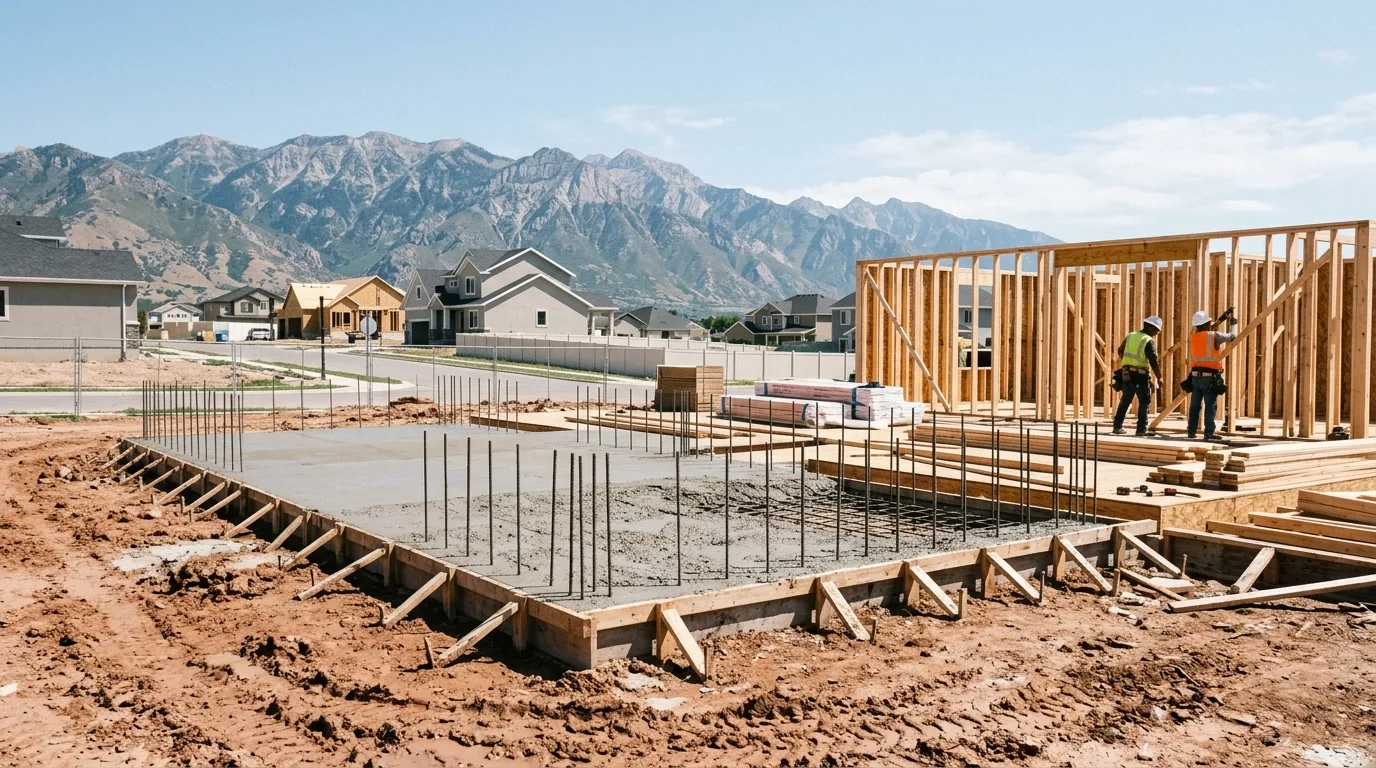
When Holladay homeowners build additions, accessory dwelling units, or new homes, the foundation type decision comes up early in the design process. Poured concrete foundations and CMU (concrete masonry unit) block foundations are both permitted and used in Salt Lake County — but they perform differently in Holladay’s specific combination of expansive clay soils, seismic activity, and freeze-thaw climate. This comparison gives you the context to make an informed decision for your project.
In this post, we cover how poured concrete and CMU block foundations compare structurally, which performs better in Holladay’s seismic and soil conditions, cost differences, and what Holladay’s permit process requires for each.
Foundation Installation in Holladay, UT
Holladay Concrete Pros installs poured concrete foundations engineered for Salt Lake County's soils and seismic requirements.
Why Foundation Type Matters More in Holladay
Most of the United States can treat foundation type selection as primarily a cost and availability decision. Holladay’s location on the Wasatch Front changes that calculus. Holladay sits in Seismic Design Category D (minimum), with many sites requiring Category E — among the highest seismic design requirements in the country outside of California and the Pacific Northwest. The 1934 Hansel Valley earthquake and more recent (though smaller) Wasatch Front events are reminders that seismic design is not theoretical here.
Additionally, Salt Lake County’s expansive clay soils, as found throughout the Olympus Hills and Olympus Cove neighborhoods, create ongoing differential settlement risk that foundations must be designed to resist. The combination of seismic and soil conditions makes Holladay a market where engineering quality matters more than average — and where the difference between a well-engineered foundation and an adequate one shows up over decades.
Types of Foundation Approaches in Holladay
Poured concrete foundation (PIP — pour-in-place): Concrete is formed and poured monolithically, creating a continuous structural wall without joints between masonry units. The resulting structure has high compressive and tensile strength, fewer potential water infiltration points, and better resistance to lateral (seismic) loading because the wall acts as a single structural element rather than a collection of masonry blocks.
CMU block foundation: Concrete masonry units (typically 8×8×16 inch hollow blocks) are laid in courses with mortar joints, then usually filled with grout and reinforced with vertical rebar in the cores. CMU construction is slower and more labor-intensive than poured concrete, but is widely used and can be high-quality when properly reinforced.
Hybrid systems: Some Holladay foundations combine poured footings with CMU walls above grade, or use insulated concrete forms (ICF) — a specialty system that provides integrated insulation with poured concrete structural walls.
Practical Considerations for Each System
- Seismic performance: Poured concrete foundations with proper reinforcement perform better than CMU in seismic events because the monolithic structure has no masonry joints to open. Seismic forces that shift a CMU foundation can crack mortar joints and compromise structural integrity; a properly reinforced poured concrete wall typically remains intact.
- Water infiltration: Poured concrete has fewer potential leak paths than CMU — the mortar joints in CMU construction are the weak points for water infiltration into below-grade spaces. Proper waterproofing addresses this for both systems, but CMU requires more careful joint treatment.
- Cost: CMU foundations are often quoted at a slightly lower cost than poured concrete for equivalent wall heights because of lower form cost — CMU block doesn’t require the same forming and stripping sequence. However, the reinforcement, grouting, and quality control required for seismic-compliant CMU construction in Holladay often reduces this cost differential.
- Speed: Poured concrete sets faster than CMU construction, which proceeds course by course. For time-sensitive projects, poured concrete typically completes structural foundation work faster.
- Repair and modification: CMU walls are easier to modify after the fact — cutting individual blocks is more practical than cutting poured concrete. For residential projects where future modifications are anticipated, this is a consideration.
- Soil bearing: Both systems transfer loads to the footing, which must be designed for Holladay’s specific soil bearing capacity. Geotechnical investigation is recommended for either system in Salt Lake County’s variable clay soils.
Concrete Foundation Installation in Holladay
Holladay Concrete Pros manages engineering coordination, permitting, and installation — call (888) 376-0955 for a project consultation.
How Holladay’s Seismic Requirements Apply
Both poured concrete and CMU foundations must be designed to meet Holladay’s Seismic Design Category D or E requirements. For CMU systems, this means reinforced hollow cores, specific mortar mix requirements, and connection detailing between the foundation wall and the structural framing above. For poured concrete, this means reinforcement design per ACI 318 Seismic provisions and proper anchor bolt placement for the sill plate connection.
Neither system is inherently disqualified from use in Holladay — both are used and both can meet code when properly engineered. The key is that both require a licensed structural engineer to design the reinforcement, detailing, and connections for Holladay’s seismic zone. Contractors who propose to build foundations without engineering documents in Holladay’s seismic environment are presenting a code compliance risk that will surface at inspection.
Holladay’s building permit process requires engineering documentation for all foundation work. Plan review through the iWorq portal targets 7 business days, with up to 14 business days for complex structural reviews. We coordinate the full permit process for foundation projects including liaison with the structural engineer of record.
Cost Factors for Foundation Work in Holladay
Foundation costs in Salt Lake County vary significantly based on scope and soil conditions. Poured concrete foundations for residential additions typically run $5,000–$15,000 depending on wall height, length, and soil conditions. CMU foundations for comparable scope are similar or slightly lower. Full new construction foundations range from $15,000–$50,000+ for either system depending on size.
The cost variable that matters most in Holladay is the soil investigation and engineering cost, which applies equally to both systems. A geotechnical report for a typical residential addition runs $1,500–$3,000. Structural engineering for the foundation design typically runs $1,000–$3,000 depending on complexity. These fixed costs mean that the system-type decision (poured vs. CMU) has less impact on total project cost than the soil conditions and engineering requirements specific to your Holladay site.
Frequently Asked Questions
Which foundation type is better for Holladay’s seismic zone?
Poured concrete foundations with proper seismic reinforcement generally outperform CMU in seismic events due to the monolithic structure’s superior lateral load resistance. Both systems can meet Holladay’s Seismic Design Category D requirements when properly engineered, but poured concrete’s continuous wall structure has no mortar joint weak points under lateral loading. For the highest seismic performance in Holladay, poured concrete is the more conservative choice.
Do I need a geotechnical report for a foundation in Holladay?
Geotechnical reports are required for all commercial projects in Holladay and are strongly recommended for residential projects. Holladay’s expansive clay soils vary significantly across the city — the Olympus Cove area has different soil characteristics than the Holladay Village area — and these variations directly affect footing depth, width, and reinforcement requirements. Without a soils report, the structural engineer must use conservative assumptions that may result in over-designed (more expensive) foundations.
How long does foundation work take in Holladay?
A simple addition footing takes 2–4 days for excavation, forming, pour, and strip. A full residential basement foundation takes 1–3 weeks. Foundation permit review through Holladay’s iWorq portal takes 7–14 business days. Total project timeline from permit submission to ready-for-framing typically runs 4–6 weeks for residential addition foundations. Begin the permit process well before your target construction start date — we recommend applying at least 4 weeks before your desired start.
Expert Foundation Concrete in Holladay
Call Holladay Concrete Pros at (888) 376-0955 — we coordinate engineering, permitting, and installation for foundation projects throughout Salt Lake County.
Related: