
Holladay RV Pad Concrete: What Homeowners Need to Know
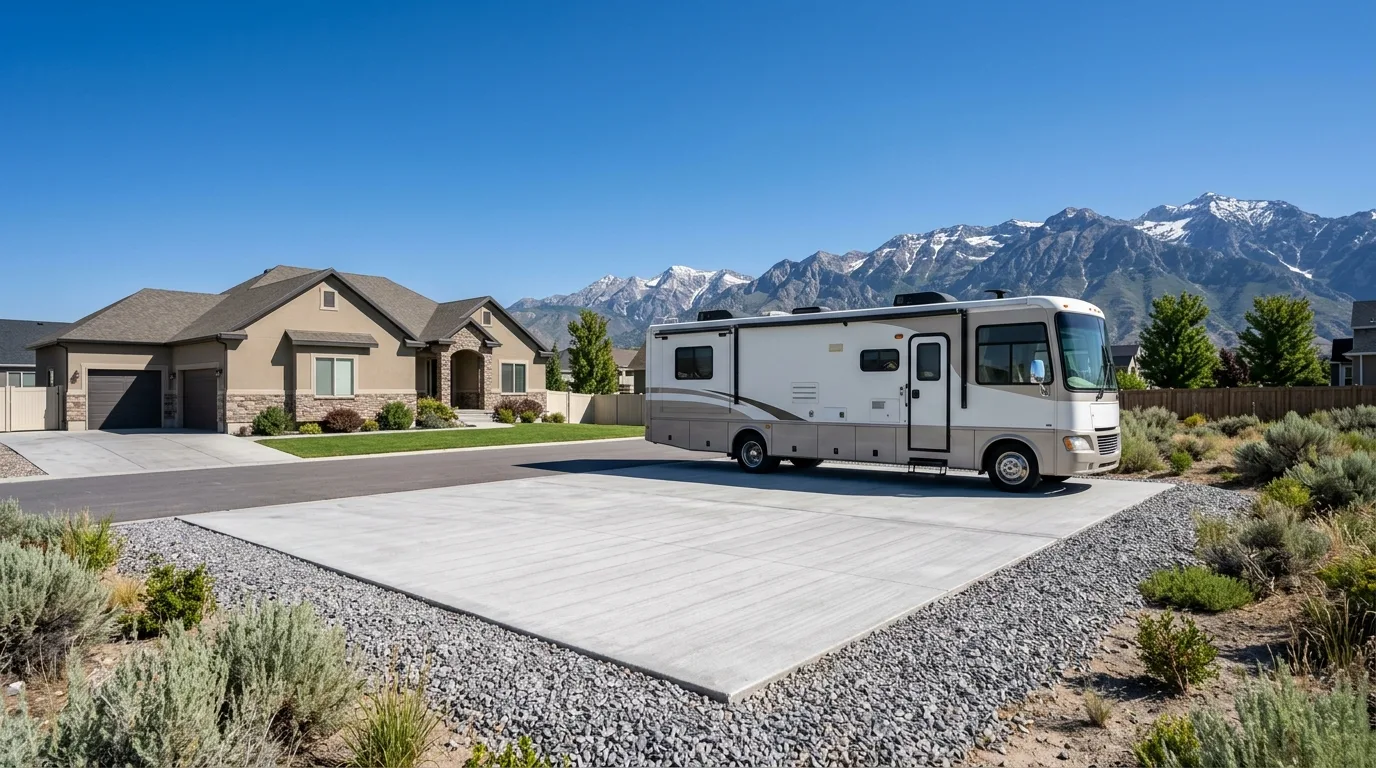
RV ownership is growing across Salt Lake County, and Holladay homeowners with adequate lot space are increasingly looking to add dedicated concrete RV pads rather than parking on lawns, gravel, or the public street. A properly installed concrete RV pad handles the load of a fully loaded Class A motorhome, resists the freeze-thaw cycling of Holladay’s winters, and meets the city’s zoning requirements for accessory pads.
In this post, we cover RV pad sizing and design, what Holladay’s permit process requires, why concrete is the right material for heavy-vehicle pads in this climate, and what the project typically costs in Salt Lake County.
Get a Free RV Pad Estimate in Holladay
Holladay Concrete Pros installs concrete RV pads sized and spec'd for Utah's freeze-thaw climate — free written estimate.
Why Concrete Is the Right Material for RV Pads in Holladay
An average Class A motorhome weighs 20,000–30,000 pounds. A fifth wheel and truck combination reaches similar loads. These are point loads — the weight concentrates on individual tire contact patches — that require a structurally capable surface to avoid rutting, cracking, and sinking. Asphalt softens significantly in Holladay’s 91°F July heat, creating permanent ruts where RV tires rest for weeks at a time. Gravel provides no continuous surface support and allows the heavy vehicle to sink into soft spots. Concrete — properly specified and reinforced — handles RV loads without deformation across Holladay’s full temperature range.
The freeze-thaw challenge for RV pads is identical to any other concrete surface in Salt Lake County: air-entrained 4000–5000 PSI concrete is required for durability through 100+ annual freeze-thaw cycles at Holladay’s 4,465-foot elevation. An RV pad that cracks and heaves after three winters is not an acceptable outcome for a $3,000+ investment. The correct specification at installation prevents this outcome.
Types of RV Pad Configurations in Holladay
Side extension from existing driveway: The most common configuration — extending an existing concrete driveway laterally to create a dedicated pull-in space beside the home or garage. This requires Holladay’s Zoning and Engineering compliance review and must maintain setback requirements from property lines.
Rear lot pad with access path: A dedicated pad in the rear yard with a concrete access path from the street or driveway. More expensive due to the length of concrete path required, but allows the RV to be stored away from the street — which some neighborhoods and HOAs prefer.
Dedicated pull-through pad: A pad that allows the RV to pull in from one end and exit from the other without backing maneuvers. Requires more lot area but is the easiest operational configuration for large rigs.
Pad alongside garage: Positioned alongside a detached or attached garage, using the garage wall as one edge reference. Common in Olympus Hills and Holladay Village areas where side yards are narrower.
Practical Uses for Concrete RV Pad Installations
- Primary RV parking: A 12×40 ft pad for a Class A or Class C motorhome next to the driveway — the standard size for single-axle to tandem-axle RVs. At $2,000–$4,000 installed, this is the most common project size.
- Fifth wheel or trailer parking: Wider pads (14–16 ft) accommodate fifth wheels with significant slide-out extensions when deployed. The concrete slab allows slide-outs to be used without the risk of sinking into soft ground.
- Boat and trailer parking: The same pad specifications work for boat trailers — concrete handles the point loads from trailer jacks and provides a stable surface for trailer leveling.
- Combination pad (RV + extra parking): Some Holladay homeowners pour a wider pad (20–24 ft) that serves double duty as RV storage and additional vehicle parking when the RV is not present.
- Sport court base adjacent to RV pad: Homeowners adding RV storage to the side yard often combine the project with a sport court installation on the same concrete pad — the additional cost per square foot decreases on larger pours.
Holladay RV Pad Concrete Installation
We size, spec, and permit RV pads for Holladay properties — call (888) 376-0955 for a free estimate.
How Holladay’s Permit Process Applies to RV Pads
Holladay explicitly lists RV pads as requiring a no-fee Zoning and Engineering compliance review before work begins. The review is submitted through the city’s iWorq online portal and takes approximately 7 business days for first review. The review covers:
- Setback requirements: RV pads must maintain required setbacks from property lines per Holladay’s zoning code. Side yard setbacks vary by zoning district — confirm with Holladay’s Building Division at 801-527-3890.
- Lot coverage: Holladay limits the percentage of a lot that can be covered by impervious surface. An RV pad adds to this total, and lots near the limit may face restrictions on pad size.
- Drainage compliance: The Engineering review ensures that drainage from the new impervious surface is directed appropriately and doesn’t increase runoff onto neighboring properties.
We handle the iWorq submission for all our RV pad projects and coordinate with the city’s review process so that work begins only after approval is received. Homeowners in the Olympus Hills and Knudsen’s Corner neighborhoods with active HOAs should also check HOA requirements separately — city approval and HOA approval are independent processes.
What Affects the Cost of a Concrete RV Pad in Holladay
Concrete RV pads in Holladay typically run $2,000–$4,000 for a standard 12×40 ft single-RV pad (480 sq ft). Larger pads, wider pads, or combinations with driveway extension increase cost proportionally. At $8–$15 per square foot for standard broom finish, an RV pad is priced within the same range as driveway work of comparable area.
Cost factors specific to RV pads: thickness matters more than for patios — RV pads should be 5–6 inches thick with rebar (not just fiber mesh) for heavy-vehicle load ratings. The subgrade must be compacted to support point loads without settlement. Access paths from the street or driveway to the pad add to total cost but may be required for operational use. In Salt Lake County’s clay soil conditions, subgrade preparation adds cost but is the foundation of long-term pad performance.
Frequently Asked Questions
What size concrete RV pad do I need in Holladay?
Minimum dimensions depend on your specific RV. Most Class A motorhomes need at least 12 ft wide × 40 ft long, with larger coaches needing 14 ft wide. Fifth wheels with slide-outs typically need 14–16 ft wide to accommodate extensions. Add 2–3 ft of clearance on each side of the vehicle width for comfortable access. Check Holladay’s setback requirements for your zoning district before finalizing dimensions — this affects how close to the property line the pad can extend.
Does Holladay allow RV pads in residential zones?
Holladay allows concrete RV pads in residential areas subject to the no-fee Zoning and Engineering compliance review. Setback, lot coverage, and drainage requirements apply. Some neighborhoods also have HOA restrictions on RV storage and pad placement that are separate from city requirements. Check both the city’s requirements (801-527-3890) and your HOA’s CC&Rs before starting the permitting process. See our concrete permits guide for Holladay.
How thick should an RV pad concrete be?
For heavy vehicle loads (Class A motorhomes, fifth wheels), a 5–6 inch concrete slab with rebar reinforcement is the appropriate specification in Holladay. Standard patio concrete at 4 inches with fiber mesh is not adequate for repeated RV loads. The thicker slab and rebar reinforcement cost more than standard patio specs but are required for the pad to perform without cracking under heavy point loads over Holladay’s freeze-thaw cycling winters.
Get Your Holladay RV Pad Installed Correctly
Call Holladay Concrete Pros at (888) 376-0955 — we spec, permit, and install RV pads throughout Salt Lake County.
Related: