
5 Signs Your Holladay Driveway Needs Replacement
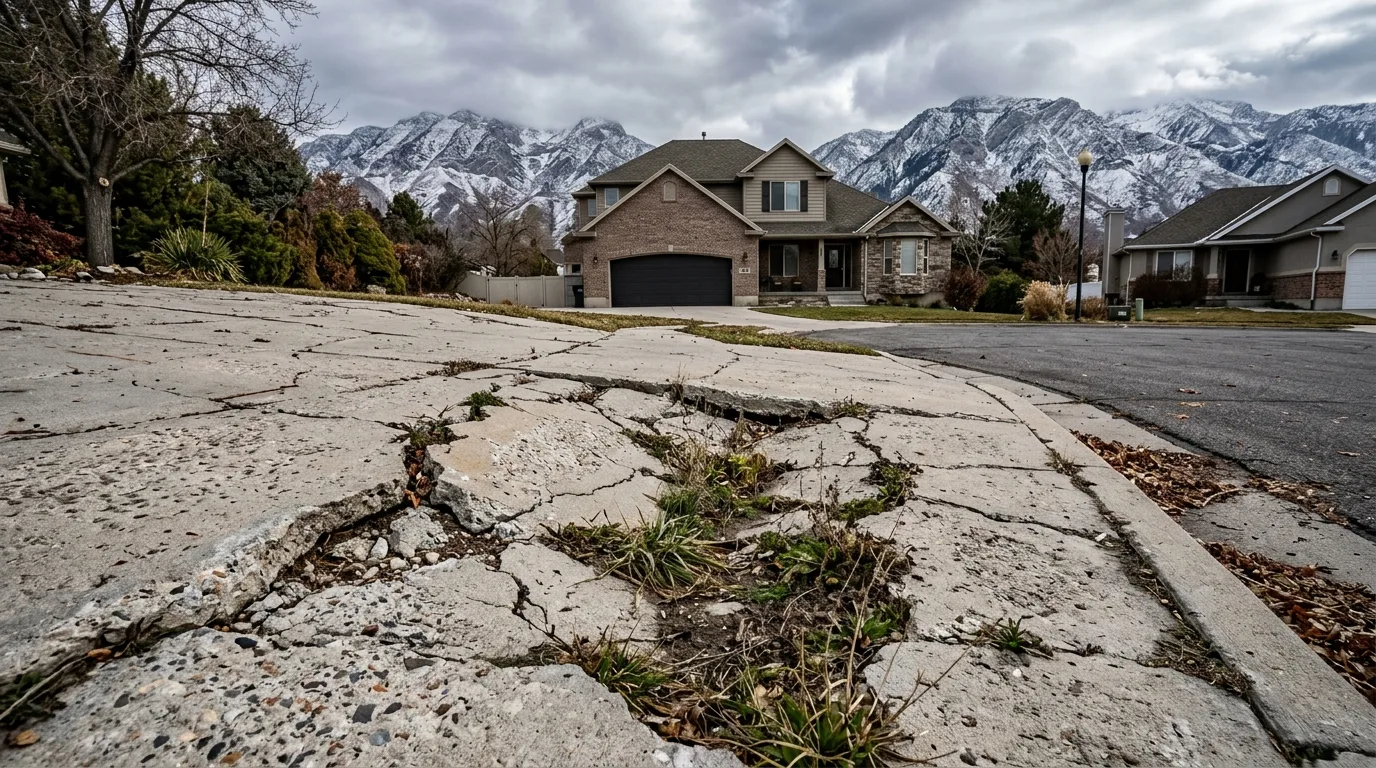
Every homeowner with an aging concrete driveway in Holladay faces the same question eventually: is this repairable, or am I throwing money at a surface that’s going to fail anyway? The wrong answer costs real money either way — premature replacement wastes thousands on a driveway with years of life left, while repeated repairs on a failing driveway extend the problem without solving it.
In this post, we cover the five clearest signs that replacement is the right call, what each sign means structurally, how to distinguish fixable damage from structural failure, and what to expect from a Holladay driveway replacement project.
Free Driveway Assessment in Holladay
Not sure if you need repair or replacement? We'll give you an honest evaluation — free, no pressure.
Why This Question Is Harder in Holladay Than in Other Markets
Holladay’s 100+ annual freeze-thaw cycles at 4,465 feet elevation don’t just damage concrete — they accelerate damage in ways that aren’t always visible on the surface. A crack that looks manageable from the street may have allowed water infiltration through multiple winters, undermining the subgrade and producing voids beneath the slab. In Salt Lake County’s expansive clay soil conditions, surface damage and subsurface failure often develop together, which is why an honest assessment requires more than a visual inspection.
The baseline question is always: is the structural integrity of the slab intact, or has the damage penetrated through the full depth and compromised the subgrade beneath? Surface damage on a structurally sound slab is repairable. Through-slab damage over a compromised subgrade is a replacement situation in Holladay’s climate — repair materials applied over voids will fail within one or two winters.
Types of Driveway Damage: Repairable vs. Replace
Surface scaling and minor cracks (Repairable): Surface scaling — the concrete peeling away in thin layers — and hairline cracks (under ¼ inch wide) are typically repairable with appropriate polymer-modified mortars and resurfacing products. If the underlying slab is solid and the subgrade drainage is adequate, resurfacing can restore the surface for 10–15 more years.
Widespread through-slab cracking (Replace): Cracks that span the full width of the driveway in multiple locations, cracks that are wider than ½ inch, or a pattern of intersecting cracks that divide the slab into multiple independent sections indicate structural failure. These are replacement situations — surface repair cannot restore structural integrity to a slab that has fractured throughout.
Settled or heaved sections (Assess): Sections that have settled more than 1 inch or heaved significantly typically indicate subgrade failure — either a void has formed beneath the slab or the clay soil has experienced significant movement. Minor settlement (under ½ inch) can sometimes be addressed with mudjacking. Significant or uneven settlement usually warrants replacement with proper subgrade correction.
Practical Signs That Point to Replacement
- The driveway is more crack than concrete. If you look at the surface and see a network of cracks dividing the slab into sections smaller than 3–4 square feet, structural integrity is gone. Filling those cracks is temporary cosmetics, not a repair.
- Multiple sections have shifted independently. When adjacent driveway sections have settled or risen at different rates, the subgrade beneath is failing — and no surface repair addresses that. Without fixing the subgrade, any repair will re-crack as the sections continue moving.
- Water is draining toward your house. A driveway that has settled or heaved so that water flows toward your foundation instead of away from it is a drainage failure. This is both a concrete problem and a foundation risk. Proper replacement includes re-grading for correct drainage slope.
- The surface is scaling away rapidly. One season of surface scaling is a warning. Rapid progressive scaling — where the exposed area doubles each winter — indicates the concrete was not properly air-entrained when installed and is losing structural integrity layer by layer.
- Visible rebar is rusting and lifting the surface. When reinforcing steel begins to corrode, it expands — pushing the concrete surface upward in irregular patterns. This is called concrete cancer and cannot be repaired on a whole-driveway basis. Replacement is required.
- The driveway is 25+ years old with accumulated damage. Older driveways in Holladay that were installed without proper air-entrained concrete and have accumulated multiple damage types are often past the economic repair threshold. The cost of multiple repairs often approaches replacement cost without providing replacement-quality results.
Holladay Driveway Assessment — Free and Honest
We'll tell you exactly whether repair or replacement makes sense for your specific driveway. Call (888) 376-0955.
How Holladay’s Climate Accelerates These Signs
Each winter that passes without concrete sealing, Holladay’s freeze-thaw cycles do progressive damage. The mechanism: water enters surface cracks, freezes at Holladay’s January average low of 22°F, expands by approximately 9% in volume, and mechanically widens the crack. On the next thaw, slightly more water enters the now-wider crack. This cycle — on repeat 100+ times annually — turns a 2mm surface crack into a 10mm structural crack over 3–5 winters.
Clay soil movement in the Knudsen’s Corner and Olympus Hills areas of Holladay amplifies the problem from below. Seasonal clay expansion pushes sections up; dry-season contraction creates voids below sections. A driveway that shows surface cracking above and has void formation beneath is reaching the end of its service life regardless of how the surface looks in any given spring.
The practical implication: in Holladay’s climate, the window between “repairable” and “need replacement” is narrower than in more temperate markets. Delaying a needed repair by even two or three winters can move a repairable situation into replacement territory. Early action saves money in this climate.
Cost Factors: Repair vs. Replacement Decision
Repair is the right call when: damage is surface-only, the subgrade is sound, drainage is adequate, and the total repair cost is under 40–50% of full replacement cost. In Holladay, full driveway replacement runs $6,000–$12,000 for standard broom finish. If a repair estimate comes in under $3,000–$4,000 and addresses the root cause, repair likely makes economic sense.
Replacement is the right call when: cracks are widespread through the full slab, subgrade has failed requiring correction, multiple previous repairs have failed, or the driveway is over 25 years old with multiple damage types. A replacement with proper subgrade preparation and air-entrained concrete spec sets you up for a 30–50 year driveway lifespan — one that won’t need this same conversation again for a generation.
Frequently Asked Questions
How do I know if my Holladay driveway has subgrade failure?
The clearest sign of subgrade failure is a slab that rocks or moves underfoot — you can feel the give. Sound a section by walking across it; a hollow sound vs. solid thud indicates a void beneath. Visible gaps between the slab bottom and the ground at the driveway edge are also diagnostic. An honest contractor will probe around the perimeter and assess the subgrade condition before making a repair vs. replace recommendation.
Can I repair a cracked Holladay driveway and get 10 more years out of it?
Yes — if the damage is surface-level, the subgrade is intact, drainage is adequate, and the repair addresses the root cause (typically drainage or moisture infiltration). Resurfacing overlays on sound slabs last 10–15 years in Holladay with proper sealing. The key word is “sound” — overlays applied to slabs with void formation or subgrade failure will fail within 1–2 winters regardless of overlay quality. See our concrete repair services page for what repair involves.
What should a free driveway assessment in Holladay include?
A thorough assessment includes: visual inspection of crack pattern (size, width, distribution), sounding the slab for voids, checking drainage direction and slope, evaluating any visible heaving or settling, and checking the driveway age against typical service life for the installation quality. The result should be an honest recommendation — repair, replace, or a phased approach — with written options for each path.
Get an Honest Assessment of Your Holladay Driveway
Call Holladay Concrete Pros at (888) 376-0955 — we'll tell you exactly what your driveway needs, no upsell.
Related: